
Environment: the impact of our healthcare on a healthier world
What is UMC Utrecht doing to limit CO2 emissions?
It is time to live in balance with what the planet can sustain. Health within planetary boundaries, for people now and for generations to come. With 7 percent of CO2 emissions and 13 percent of raw material consumption in the Netherlands, healthcare has a major impact on the environment. We aim to reduce that impact.
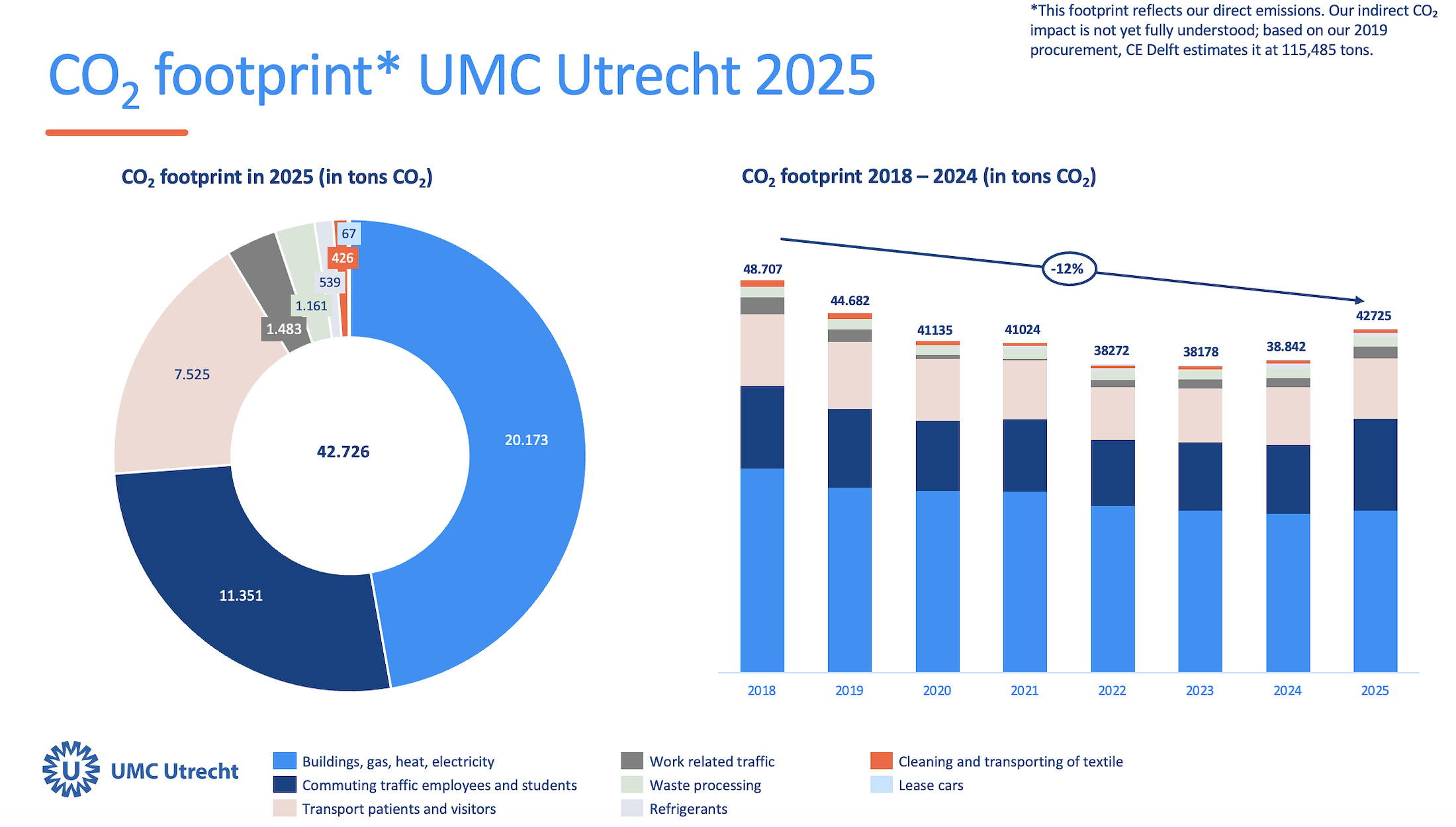
In 2025, we saw a small increase in our total CO2 emissions. Mainly due to an increase in emissions from colleagues' commuting and patient transport. The emissions from our buildings and other categories remained virtually unchanged. The increase is partly related to higher production: in 2025, there were more admissions and outpatient treatments than in 2024. In addition, we have been registering commuting in a different way since 2025. As a result, we now have a better picture of how colleagues travel and can implement more targeted actions in the coming years.
In 2025, we continued reducing the footprint of our buildings. We optimized our Combined Heat and Power (CHP) installation and installed more than 1,000 LED lights in the ICU. We also continued sustainability improvements in our buildings. At the Wilhelmina Children's Hospital, we continued insulating the façade and installing a sustainable climate system. At the same time, we prepared new steps. Heat pumps will be installed at the Wilhelmina Children's Hospital in 2026, and we have determined how to sustainably design future renovations. In doing so, we focus not only to energy consumption, but also to circularity, climate resilience, and a healthy, green environment.
What is UMC Utrecht doing to reduce the use of raw materials?
In 2025, we launched and continued several projects to reduce our use of raw materials and increase reuse and recycling. In 2024, we began separating residual waste, allowing plastic to be filtered for recycling. In 2025, we saw the results: we now recycle more than 50 percent of our waste. We are also working on more sustainable waste collection. For example, in February 2026, we will introduce needle containers made from recycled materials.
To further reduce the percentage of residual waste to a maximum of 25 percent, we conducted several studies in 2025. We identified the 50 most commonly used disposable products. This led to research into recycling blood tubes and tissue paper, as well as finding a solution for the remaining disposable coffee cups.
We also took steps to reduce waste. For example, our cardiac catheters are now reprocessed. These catheters are normally intended for single use, but our partner Vanguard prepares them for reuse up to four times. This saves raw materials and reduces costs.
In 2025, we also stopped using disposable coveralls, caps, and shoe covers for parents accompanying their child to the operating room. This eliminates around 20,000 sets per year – reducing waste by approximately 2,500 kilograms. At the same time, this change reduces unnecessary steps in care and, above all, creates more calm and confidence for both child and parent.