
Governance: our impact on fair and reliable healthcare
What is UMC Utrecht doing in innovation to improve care?
Innovation is essential to keeping care accessible, safe, and affordable. At UMC Utrecht, we use technology and data purposefully to improve care – always with attention to people, reliability, safety, and ethics.
From the laboratory to the patient
At UMC Utrecht, we connect care and research every day. We bring what we discover in the laboratory to practice as quickly as possible – so that patients benefit directly.
In 2025, we treated the first patients with a new technique for cardiac arrhythmias. This innovative approach enables more targeted treatment while sparing surrounding tissue. It represents an important step toward safer and more precise treatment of complex arrhythmias.
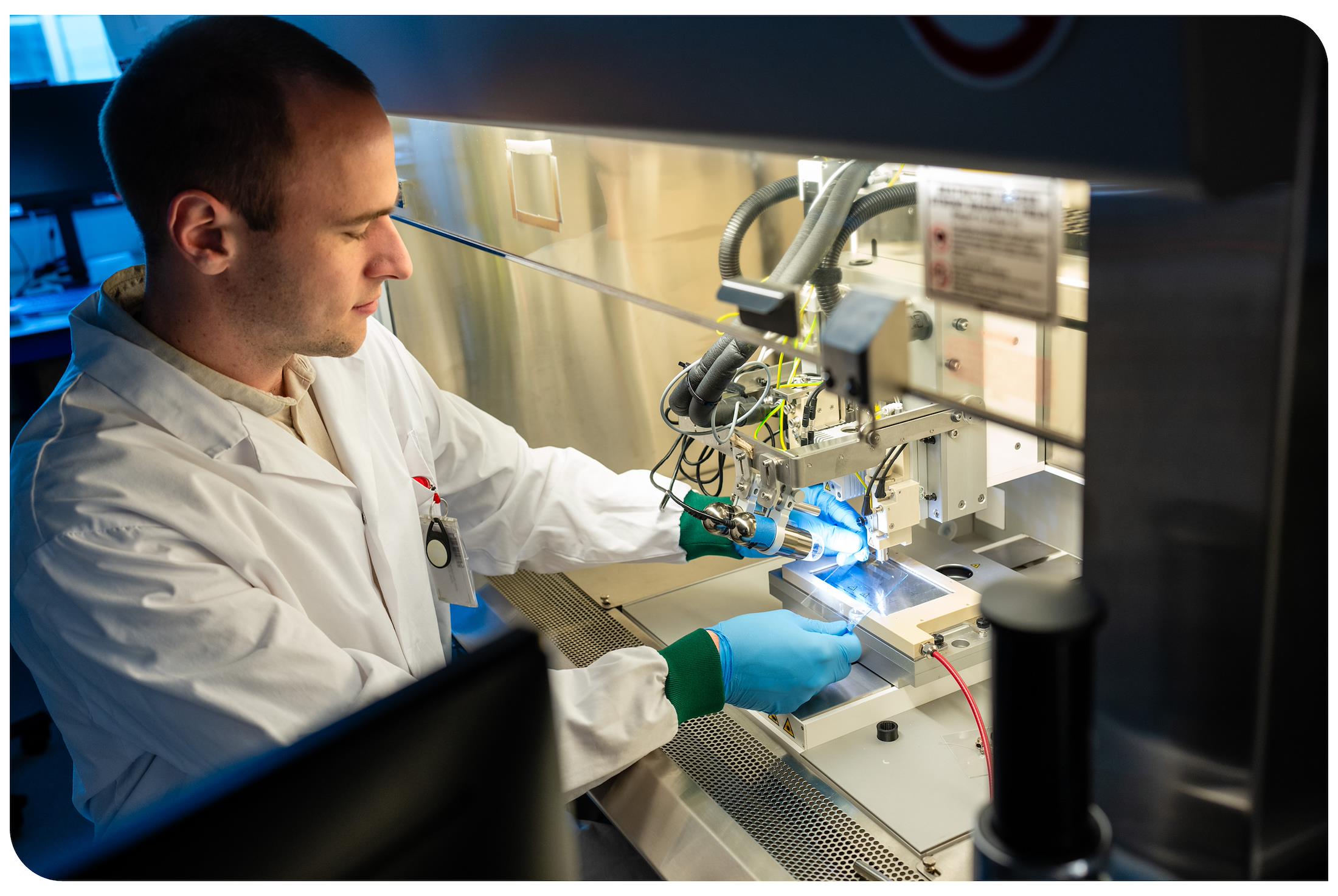
In our fundamental research, we also work on solutions that bring the healthcare of tomorrow closer. In the GRACE project, researchers use artificial intelligence to make 3D bioprinters smarter in developing tissue. In this way, the printer becomes a 'partner' of the researcher, as it were. This accelerates the development of new applications in regenerative medicine.
Read more about our research with impact on patients and valorization.
Continuous monitoring: in the hospital and at home
With continuous monitoring, we track patients' vital signs 24/7 using wearable sensors. This allows us to detect clinical deterioration earlier and intervene more quickly. In 2025, we implemented a new care protocol to structurally embed continuous monitoring on two nursing wards. This increases patient safety and supports nurses in their daily work. Even when they are not standing directly at the bedside, they have a better view of their patient's condition.
Shortly before the summer of 2025, several technical and process-related issues emerged regarding the application of continuous monitoring. We therefore decided to temporarily pause further implementation. We will first resolve these issues fully to ensure the technology can be used safely and reliably. Implementation will resume in 2026.
HOME-ART: shifting hospital care to the home
Due to an aging population and pressure on bed capacity, we are looking for new forms of healthcare. Together with the St. Antonius Hospital and the Diakonessenhuis, we are conducting the HOME-ART study, supported by ZonMw, UMC Utrecht, and the Acute Care Network Central Netherlands.
In HOME‑ART, we investigate whether patients with an acute respiratory infection can be safely treated at home with intravenous antibiotics and/or oxygen. They wear a sensor that continuously measures vital signs. This data is monitored 24/7 by the Medical Control Center of UMC Utrecht. There is daily contact with the patient, district nurse, and treating physician. In November 2025, the first patient within the feasibility study was treated at home.
Transmural referrals
In 2025, UMC Utrecht began digital transmural referrals between care providers and the hospital, with national rollout planned for 2026. This approach ensures faster and more efficient patient flow, as referrals immediately reach the right place with the relevant medical information. In addition, it reduces the administrative burden and lowers the risk of errors. Moreover, the digital transfer from the EHR provides more complete insight into the referral and its progress.
AI in 2025: from pilot to practice
In 2025, artificial intelligence (AI) at UMC Utrecht is no longer an experiment, but part of our daily practice. Within our 3AI approach – Data, Research, Implementation, and Education – we ensure that development, scientific validation, and application go hand in hand. This is the only way to ensure AI is used safely and responsibly.
Good AI starts with secure data. The collaboration with Roseman Labs within the NSK Data Workspace was awarded a Privacy Award 2026. This recognition underscores our commitment to privacy-friendly data exchange. Although the award was presented in 2026, the partnership had already delivered a secure analysis environment in 2025. This environment enables responsible analysis of datasets with a high privacy risk.
Faster diagnostics
A concrete example is the use of AI during brain tumor surgeries. A model helps to identify the type of tumor during the operation. Where additional analysis used to take days or even weeks, targeted information is now available much sooner. This supports the surgeon in making treatment decisions during the procedure immediately during the operation. As a result, some patients need only one operation instead of two.
AI also supports pattern recognition in pathology and radiology. The specialist always remains responsible; AI supports the assessment but does not take decisions. One example from 2025 is a predictive model for patients with metastatic skin cancer (melanoma). AI can identify immune cells in tumor tissue that indicate the likelihood of success of immunotherapy. In a large UMC Utrecht study, the AI algorithm counted these cells even more accurately than pathologists. This improves the ability to predict which patients will benefit from treatment. The specialist always remains responsible; AI supports the assessment but does not take decisions.
Smarter organization of healthcare
AI also helps keep healthcare accessible. The prediction model for missed appointments (no-shows) now runs on the national HealthSage AI platform. By contacting patients in time, we use our outpatient capacity more effectively and reduce waiting times.
AI as support for administration and consultation preparation
In 2025, UMC Utrecht continued to develop and apply AI with the aim of reducing administrative burdens while maintaining the quality of healthcare. Within the Care of Tomorrow program, a pilot was conducted with the AI tool Autoscriber, which automatically transcribes, summarizes, and processes consultations into the patient file. This pilot shows that healthcare providers can pay more attention to the patient during consultations. In 2026, the tool will be rolled out more widely across outpatient clinics.
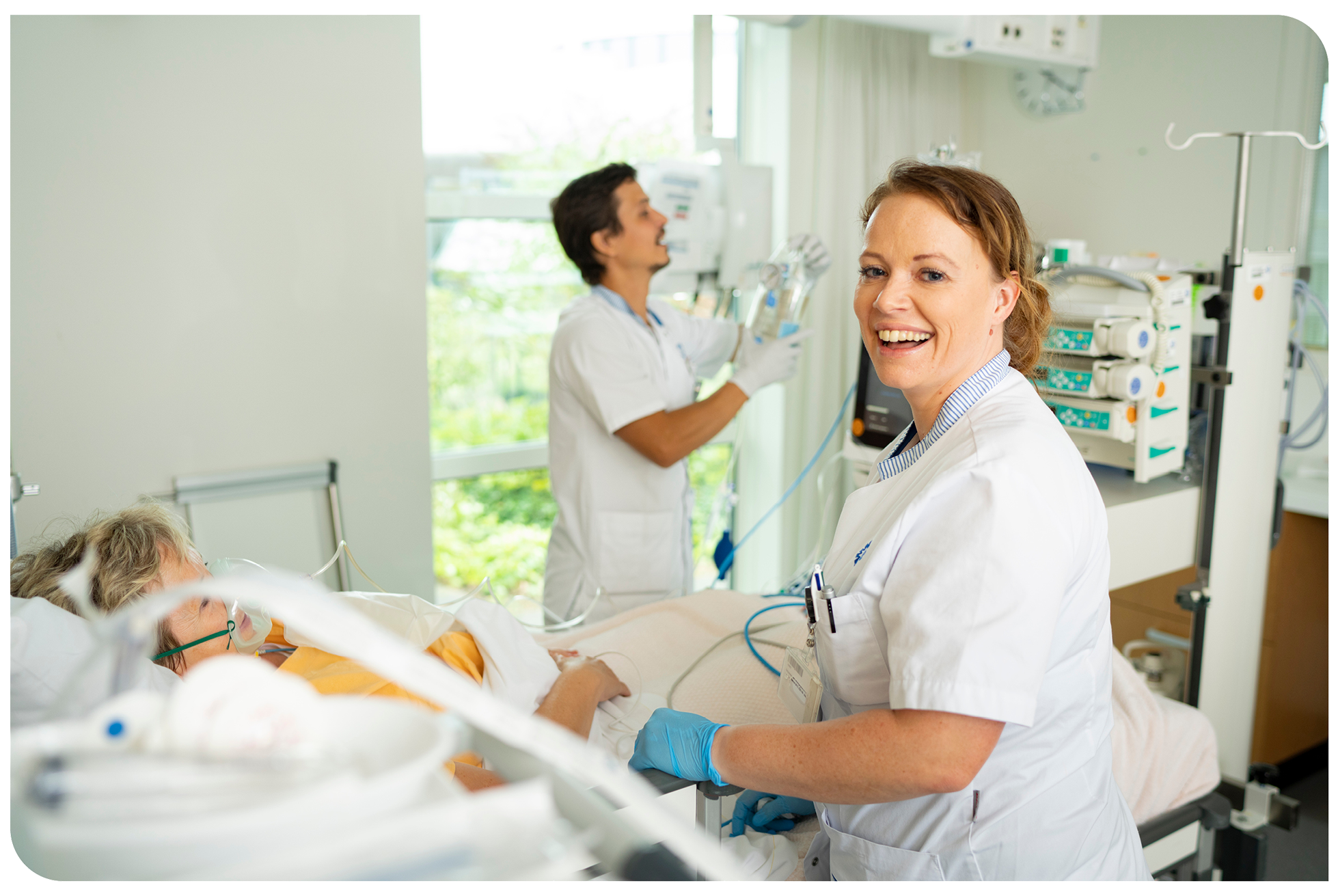
Within the AI Consultation Preparation project, we successfully tested how AI can summarize existing patient information clearly to support healthcare professionals. Steps were also taken to reduce administrative workload, including the implementation of AI-supported discharge documentation in the NICU and ICU, and preparations for broader scaling across UMC Utrecht.
AI applications also contribute to more efficient administrative processes, such as generating draft medical correspondence. Responsibility and final decision-making always remain with our healthcare professionals.